Kirie
Blind Willow, Sleeping WomanKirie is an independent-minded window cleaner and aspiring steeplejack whose pursuit of height defines both her work and her intimacy. She tells Junpei that she cannot sustain a serious everyday relationship because emotional involvement might distract her from what she is doing; later, he hears her describe high places as a world shared with the wind, with no room for anyone else. When contact between them quietly ceases, her chosen solitude proves stronger than the relationship.
Identity and First Meeting
Kirie gives Junpei her name during a conversation about prizes, dismissing them as an industry gimmick. Junpei replies that he would be more convinced if he heard that from someone who had actually won one. Her name prompts him to think of “Kyrie” from a mass, but the introduction quickly becomes an encounter with a strikingly individual presence.
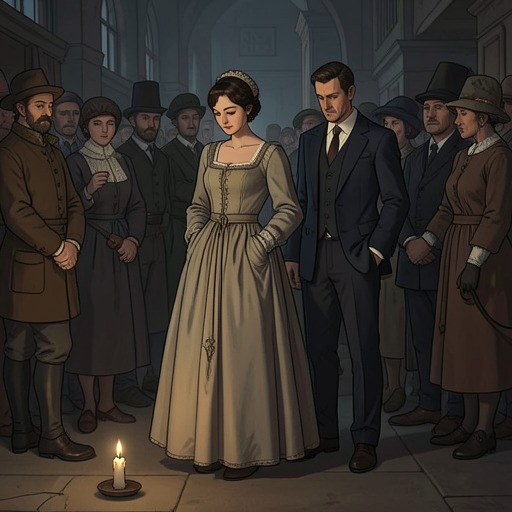
Junpei estimates that Kirie may be an inch or more taller than he is. She has short hair, a deep tan, and a beautifully shaped head. Her clothes—a pale green linen jacket with sleeves rolled to the elbow, a simple cotton blouse, a small turquoise brooch, and a knee-length flared skirt—are stylish without seeming affected. Her full lips spread or purse at the ends of her sentences, lending her manner a liveliness that Junpei finds unusual; three parallel lines appear across her broad forehead when she stops to think, then disappear when she is done. The details give her appearance a sense of active thought rather than fixed polish.
Work and Chosen Direction
Kirie explains that her profession is the work she wanted to do from childhood, though the route toward it was difficult. She first became a securities analyst, but immediately knew the job was wrong for her. After three years she left the firm, and her first move was to take a job washing windows in tall buildings. Her ambition was to become a steeplejack, but she found that the field was so strongly male that women were not readily admitted. Window cleaning became, for the time being, a practical way to work at height.
The change from financial analysis to window washing is striking, but Kirie says the latter is much less stressful: if something falls, she says, it is she herself who is at risk, rather than stock prices. Her work is not simply a substitute for the occupation she wants. It keeps her close to the heights that have attracted her since childhood while she pursues a path in a world that makes entry difficult for women.
Kirie also organizes high-altitude performances. Junpei later hears that she gathers sponsors and performs on tall buildings; she has recently performed at a famous cathedral in Germany. She wants permission to perform on higher structures and to keep challenging herself with buildings a little taller than the last. At those heights, a safety net would not help if she fell. The risks are part of the circumstances of her chosen work, not a reason for her to abandon it. Because she cannot earn a living from performing, she also has a window-cleaning company. She will not take circus work, even if tightrope walking there were possible: her interest is specifically in high-rise buildings.
Intimacy and Independence
Kirie states the terms of her relationship with Junpei plainly. She cannot have a serious everyday relationship with anyone, not only with him, because she wants to concentrate completely on what she is doing. Living with someone or becoming deeply emotionally involved might prevent that concentration. When Junpei asks whether she means she does not want to be distracted, she agrees. Her limit is not framed as a quarrel or an accusation against him; it is a rule she applies to intimacy in general.
The distinction matters to their relationship. Kirie allows closeness, but does not promise the shared daily life that might turn it into a conventional partnership. Her work and her concentration remain central, while Junpei can only encounter them from outside. Their connection therefore has a boundary before it has a dramatic rupture: the possibility of deeper attachment is acknowledged, then refused as incompatible with the life she intends to lead.
The Wind and the Relationship’s End
In an interview heard by Junpei in a taxi, Kirie describes what happens to her at a height. She says that once she reaches a high place she changes as a human being—or must change in order to survive. There, she says, it is just her and the wind. The wind envelops and rocks her; she understands it, and it understands her. She describes the two of them as accepting one another and deciding to go on living together. In the concentrated state she enters on the high place, fear vanishes, and she finds herself inside what she calls their warm void. It is this moment she loves most.
Junpei cannot tell whether the interviewer understands her. After the interview, he stops the cab and walks the rest of the way, looking up at tall buildings and passing clouds. He realizes that no one can come between Kirie and the wind, and a violent rush of jealousy follows. He cannot settle its object: it is not another person, but the wind, the force and companionship that seem to meet Kirie where human intimacy cannot.
He waits several months for Kirie to contact him and wants to see her again, including to talk about the kidney-shaped stone. She does not call. His attempts to reach her fail with the message that the calls cannot be completed as dialed. When summer arrives, he gives up the small hope he has kept. Kirie has no intention of seeing him again, and the relationship ends without shouting or discord. Its quiet conclusion echoes the way Junpei has ended relationships with other women, as calls gradually stop and things come to an end naturally. Yet Kirie’s account of the wind gives this familiar pattern a sharper meaning: her withdrawal is consistent with the concentration and chosen solitude she had already described.